

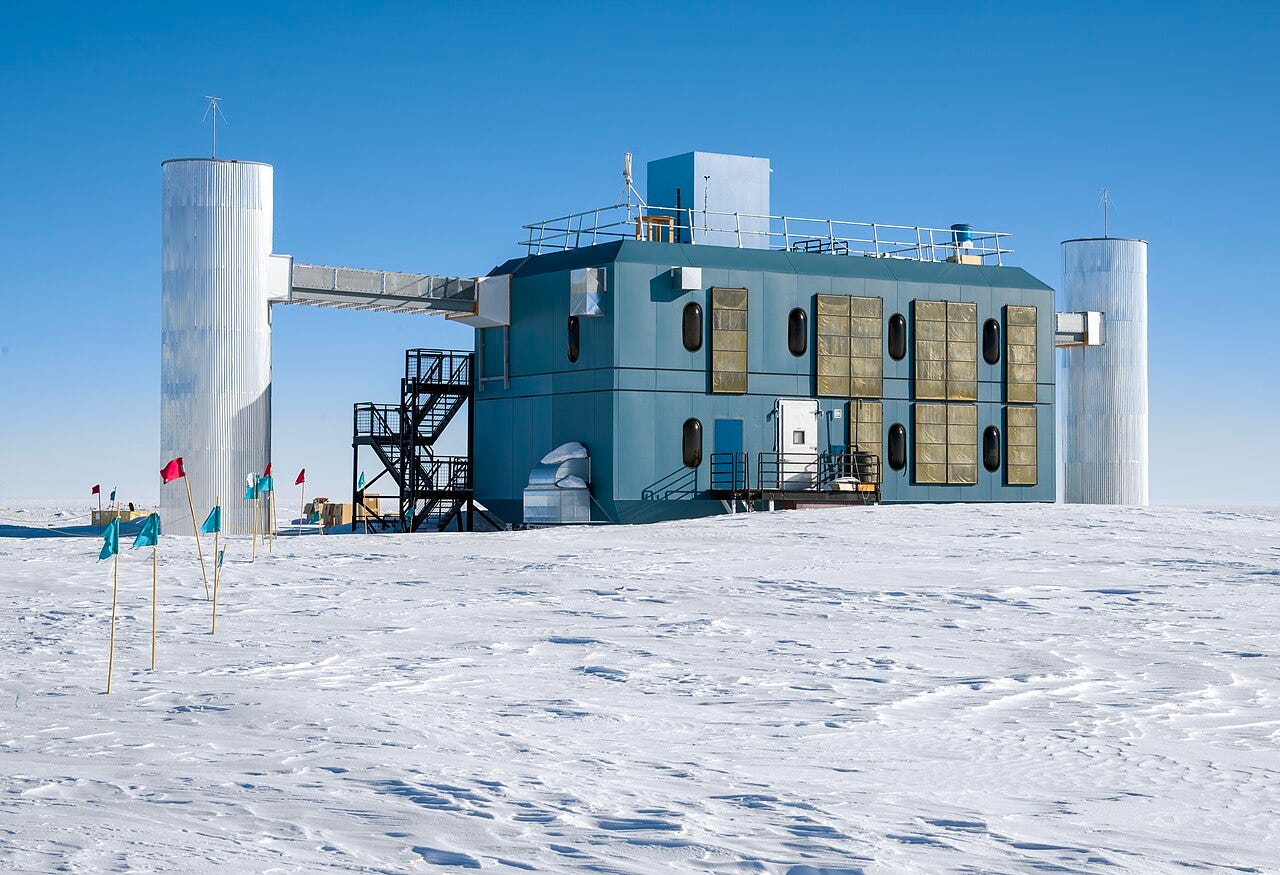
Anyone who has followed me knows that neutrinos are my favorite elementary particles. I have spent a lot of my research career thinking about them, and I think they are probably the key to extending the standard model of particle physics beyond its current stasis state.
So, given this, you may be surprised that I was a bit shocked by this year’s Nobel Prize in Physics, which happily, unlike last year’s, is at least clearly for physics research. I have known Francis Halzen for 40 years, and think he is a wonderful guy, and a brave and distinguished scientist. I admire the amazing dedication and effort he, as a theoretical physicist, put together to build the mammoth IceCube Neutrino Observatory at the South Pole. It is an engineering masterpiece and one that was not guaranteed to succeed. Yet he devoted 40 years of his life to it. And it has detected energetic neutrinos emitted by some of the most exotic processes in the universe, that may have traveled billions of light years to get to us.
But having said that, the Nobel Prize is not for ingenuity, or dedication. It is for impact, for changing the way we think about the world, or producing technology or ideas that directly benefits humanity. IceCube has this potential. It hasn’t done it yet.
It has already been useful of course. Most recently, for example, as my friend Frank Wilczek reminded me, IceCube was useful for something it didn’t see. It is sensitive to high energy neutrinos that matter arise from dark matter annihilations inside the Sun—something Frank and I and others worked on 40 years ago. So, when models were developed that might explain the recent LZ/LUX dark matter data point, IceCube was able to rule them out because these models would have produced a solar annihilation signal that wasn’t seen.
That is important, but not yet Nobel worthy.. One might want to compare it to the past two Nobel prizes for neutrino astrophysics (which, unlike the statement in the Nobel Press release, is already an existing field—IceCube has opened a new window by extending it to a new energy regime.) Ray Davis and Masatoshi Koshiba shared the Nobel Prize for building huge underground neutrino detectors that discovered and then measured neutrinos from the Sun and also from a distant supernova, not only helping us test in detail our understanding of fundamental stellar physics, but also setting up a major conundrum—the so-called Solar Neutrino Problem—that was experimentally resolved by the Nobel Prizewinning experiments led by Art MacDonald and Takaaki Kajita. So far, the observations made by IceCube of high energy neutrinos is consistent with thinking about exotic astrophysical processes, but it hasn’t produced a gotcha moment.
On the other hand, one might want to compare the IceCube prize to the Nobel prize for the discovery of gravitational waves. LIGO opened up the new field of gravitational wave astronomy, so one could say that by opening up a new window on the universe—high energy neutrino signals—IceCube is doing something similar. But even here there is a difference. The existence of gravitational waves was hypothesized as a consequence of Einstein’s General Relativity theory, but there actual existence had yet to be demonstrated. Moreover, LIGO and its successors have opened up opportunities to explore the nature of black holes and neutron stars in ways that would never have been possible before.
My hope of course is that IceCube might one day provide a similar groundbreaking discovery. Generally when we open up new windows on the universe this is what happens.
So this year’s prize acknowledges the dedication of a scientist who was willing to follow a daring dream, and who built an international team to produce a remarkable device located in one of the harshest places on Earth, with no guarantee of success, to open a new avenue to explore nature. It could be worse.
I therefore congratulate Francis, a distinguished scientist and a lovely man, and hope he has a wonderful time in Stockholm, and I hope that the Nobel committee has been prescient in acknowledging the device he spearheaded—against all odds—which may in the long run help us better understand the Universe and our place within it in new and unexpected ways.
thank you Lawrence for this wonderful overview and we, your neutrino fans, still pray every night that there is a 3rd or even 4th Nobel Prize with your well-deserved name attached to it with your 40 years of searching for the physics behind these little particles...in the meantime, take a few attempts at dark matter or finish your research on dark energy...you are on the top of the list for making that discovery...best..Richard